
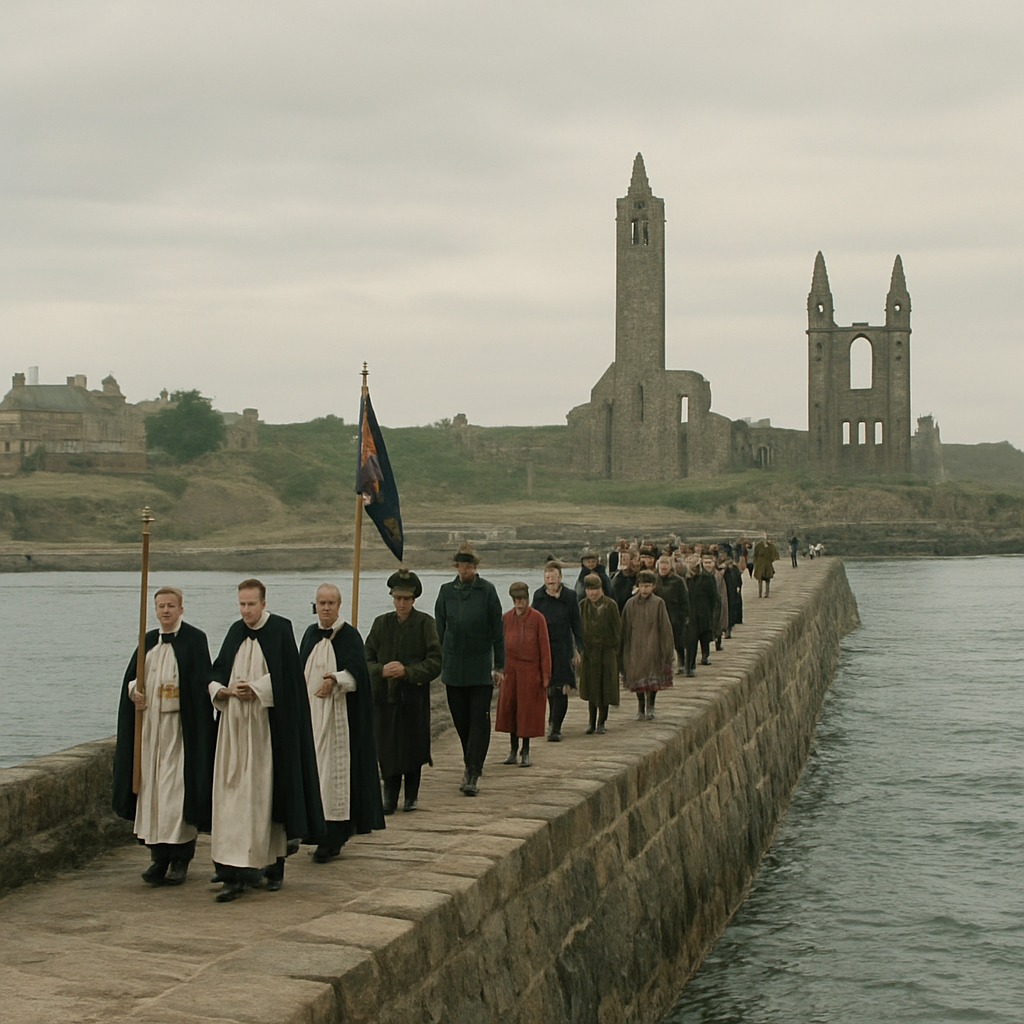
The Pier Walk & town traditions explained
St Andrews runs on ritual. Some traditions are 600 years old, some are pure student invention, but together they give the town its character. Here's what you're actually looking at when you see red gowns on the pier or foam in the quad.

Why a small town has so many traditions.
St Andrews has been a place of pilgrimage since the Middle Ages and home to Scotland's oldest university since 1413. Layer six centuries of students on top of a medieval pilgrim town and you get a place where tradition isn't performance — it's just how things are done.
Visitors often catch glimpses of these rituals without knowing what they mean. Here's the insider's key to the ones you're most likely to see.
The Sunday Pier Walk
After Sunday morning chapel, students don their scarlet undergraduate gowns and process out along the harbour's stone pier to the end and back. The tradition is said to date back centuries — originally walking to bid farewell to departing ships, or to mark respects. Today it's a weekly ritual, especially during term.
Where to watch: stand near the harbour by the cathedral end. The walk usually happens late Sunday morning during the academic term. It's a genuinely beautiful, only-in-St-Andrews sight — a river of red against the grey stone and the sea.
Etiquette: it's a public spectacle and photos are fine from a respectful distance, but it's the students' tradition, not a tourist show — give them space on the pier.
The May Dip
At dawn on the 1st of May, hundreds of students run into the freezing North Sea to cleanse themselves of academic sins. The tradition is tied to the PH cobbles outside St Salvator's — the initials of Patrick Hamilton, burned at the stake in 1528. Students who tread on the cobbles are said to be cursed unless they take the May Dip.
It happens around 4:30–5am as the sun comes up, usually at Castle Sands or East Sands. Spectators are welcome — wrap up warm, bring a flask, and you don't have to go in.
Raisin Weekend & the foam fight
In November, older students ('academic parents') take their first-year 'children' through Raisin Weekend — a riotous initiation that traditionally ended with gifting raisins to thank their mentors. It culminates on Raisin Monday with a huge shaving-foam fight, usually in St Salvator's Quad / Lower College Lawn.
It's open to watch and is gloriously chaotic. Stand back unless you fancy a faceful of foam, and don't wear anything precious.
The stories behind the street names
South, North & Market Streets
The three medieval streets were deliberately laid out in the 12th century to funnel pilgrims towards the cathedral — the whole town is a giant arrow pointing at the shrine of St Andrew.
The Pends
From the 'pended' (vaulted) gateway — the ruined 14th-century arched entrance to the cathedral priory precinct.
Logie's Lane & the wynds
The narrow lanes and 'wynds' linking the main streets are medieval rights-of-way, many named for long-gone merchants and trades.
The Scores
The clifftop road's name comes from the 'scores' — the steep gullies cut into the rock down to the shore below.
St Andrews on screen
The most famous moment: the opening scene of the 1981 Oscar-winning Chariots of Fire, with the athletes running along West Sands to the Vangelis theme. Stand on the beach and you're literally in the shot.
The town and its dramatic coast have drawn film and TV crews for decades, and the timeless medieval streets need very little dressing to play a period setting. Ask us on a tour and we'll point out the spots.
See the traditions with a local guide.
We time our private tours around the town's rhythms — the pier walk on a Sunday, the best beach for a Chariots of Fire photo, the cobbles where the story begins. Let us show you the St Andrews behind the postcards.
Enquire about a tour