

All times shown in UK time (GMT)GMT
St Andrews Shuttle
The Local's Handbook
Everything we know about St Andrews, in one place. The fount of local knowledge.
Where to park in St Andrews
The honest, street-by-street truth on parking — and when it fills.
St Andrews Heritage Trail
1,000 years of history in 12 stops. The story our drivers tell.
St Andrews secret seasons
The rhythm of the town — when it's empty, when it's packed, when it's magic.
The Pier Walk & town traditions
Red gowns, the May Dip, Raisin Monday — the rituals explained.
Ghosts & legends of St Andrews
The White Lady, the Haunted Tower, the phantom monk. Dare you walk it?
Why it's the Home of Golf
The 600-year story of how St Andrews invented the game we love.
Where to eat in St Andrews
The owners' top 10. Real menus, real bookings, real notes.
Best coffee in St Andrews
Specialty bars to the West Sands hut. Where to drink coffee that's actually good.
10 things to do in St Andrews
A local's guide. Cathedral, beach, ice cream, ruins.
Dog walks in East Fife
14 beaches, forests & hills — where dogs can actually run free.
Living in St Andrews
Groceries, markets, charity shops, jobs & transport — the newcomer's guide.
Luggage storage in St Andrews
Where to safely store your bags before check-in or after checkout.
Scottish midge forecast
When midges arrive, when they swarm, and how to keep them off you.
Rainy day in St Andrews
It's Scotland. Here's exactly what to do when the weather turns.
Accessibility guide
Cobbles, step-free routes, blue-badge parking and beach access.
Defibrillators & emergency help
Where the public-access defibrillators are, and how to use one to save a life.
University of St Andrews — term dates
Calendar, traditions, halls, peak travel days. The full guide.
+44 7902 488 770
Get a quote
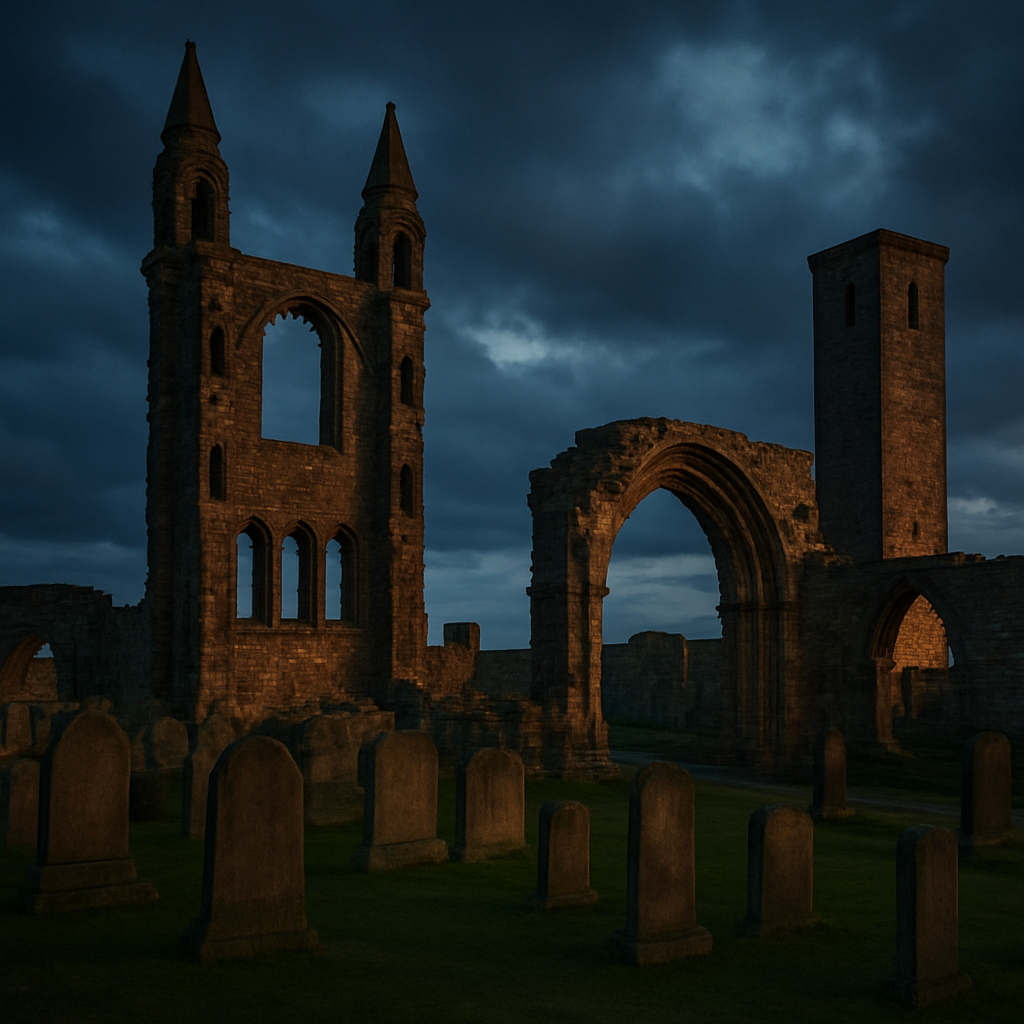
The ruins of St Andrews Cathedral and St Rule's Tower against a moody sky
The Local's Handbook

The St Andrews Heritage Trail.

A thousand years of history in twelve stops — from the apostle's relics and a ruined cathedral to a bottle dungeon, burned martyrs, a royal golf ban and the red-gowned pier walk. This is the story our drivers tell from the front seat.

12
stops
~1.5 mi
on foot
1,000+
years
Wendy
Written by Wendy
Co-owner · Fife born · 18 years in St Andrews hospitality
Reviewed by Gordon · updated
First published 20 February 2024

How to walk the trail.

The twelve stops form a natural loop that begins at the cathedral, threads through the medieval streets and the university, follows the famous golf links, and ends where the town meets the sea at the harbour. On foot it's a comfortable half-day with stops; with a driver you can cover the outlying points and save your legs for the cobbles.

Each stop below carries the date, a walking time from the previous one, the story worth knowing, and a note from us — the kind of detail we'd point out if you were in the car.

1

St Andrews Cathedral

Founded 1158Start here

Once the largest and most magnificent cathedral in Scotland, now a breathtaking ruin overlooking the sea.

Begun in 1158 and consecrated in 1318 in the presence of Robert the Bruce, the cathedral was the centre of the medieval Scottish church for 400 years. It fell into ruin after the Reformation of 1559, when reformer John Knox preached a sermon so fiery the congregation stripped the building of its 'idolatry'. Climb St Rule's Tower (the 33m square tower beside it) for the best view in Fife.

Driver's note: We drop guests at the cathedral end of North Street — there's no parking right by it, so this is where a transfer really earns its keep.
2

St Rule's Tower

c. 11301 min

The oldest building in St Andrews, predating the cathedral itself.

This 11th–12th century tower is all that remains of the earlier church of St Regulus (St Rule), the monk who legend says brought the relics of St Andrew — the apostle — to Scotland. Those relics gave the town its name and made it Scotland's most important place of pilgrimage. The 157 steps to the top are worth every breath.

Driver's note: Tell guests to go early — the tower's spiral stair is single-file and gets a queue by mid-morning in summer.
3

St Andrews Castle

c. 12004 mins

Clifftop ruin with a grim bottle dungeon and a secret siege tunnel.

The castle was the palace of the bishops and archbishops of St Andrews. Its bottle-shaped dungeon, carved into solid rock, is one of the most infamous prisons in medieval Scotland — once you were lowered in, there was no climbing out. During the siege of 1546–47 attackers and defenders dug counter-mines through the rock; you can still walk through the mine and counter-mine today.

Driver's note: The mine tunnel is low and damp — not one for anyone unsteady on their feet, but children love it.
4

The Martyrs' Monument

1842–4310 mins

A stone obelisk on The Scores remembering the Protestant martyrs.

St Andrews was the front line of the Scottish Reformation. Patrick Hamilton (1528) and George Wishart (1546) were among those burned at the stake here for their Protestant beliefs. The monument on The Scores honours them, while their initials are still set into the cobbles where they died.

Driver's note: PH cobbles outside St Salvator's — students superstitiously avoid stepping on them, or legend says they'll fail their degree.
5

St Salvator's Chapel & Quad

145012 mins

The beating heart of Scotland's first university.

The University of St Andrews was founded in 1413, making it the oldest in Scotland and the third-oldest in the English-speaking world after Oxford and Cambridge. St Salvator's College, founded in 1450, gives the town its iconic tower and cloistered quad — the backdrop to graduation processions and the famous red undergraduate gowns.

Driver's note: Graduation weeks (late June, late November) transform the town. Book transfers early — they sell out.
6

The PH Cobbles

152812 mins

Initials in the street marking where Patrick Hamilton burned.

Set into the cobbles outside the chapel are the initials 'PH', marking the spot where 24-year-old Patrick Hamilton was burned over six agonising hours in 1528 — the fire kept going out. Students avoid treading on them. Those who do are said to be cursed unless they run into the North Sea at dawn on May Day to cleanse themselves — the origin of the May Dip.

Driver's note: This links straight to the May Dip tradition — a lovely story to tell guests heading to West Sands.
7

Market Street & Mercat Cross

Medieval15 mins

The medieval marketplace, still the town's commercial spine.

St Andrews was laid out in the 12th century on three parallel streets — North Street, Market Street and South Street — all funnelling pilgrims towards the cathedral. Market Street was, and still is, where the town trades. The medieval street plan is almost perfectly preserved.

Driver's note: Best coffee and lunch stops are along here — we keep a current list on our 'where to eat' guide.
8

South Street & The Pends

14th century18 mins

A vaulted medieval gateway to the cathedral precinct.

The Pends is a magnificent ruined 14th-century vaulted gatehouse that once formed the main entrance to the cathedral priory. South Street, the grandest of the three medieval streets, is lined with merchants' houses, the old Town Kirk, and Queen Mary's House, where Mary Queen of Scots is said to have stayed.

Driver's note: The Pends archway is one of the most photographed spots in town — gorgeous in early light.
9

The Old Course & Swilcan Bridge

Golf since 1400s20 mins

The Home of Golf and its most famous little bridge.

Golf has been played on these links since at least the 15th century — so much so that in 1457 King James II banned it by Act of Parliament because it distracted men from archery practice. The ban was lifted in 1502 when James IV took up the game himself. The Swilcan Bridge on the 18th is the most photographed spot in golf.

Driver's note: You can walk the 18th and the bridge on Sundays, when the Old Course traditionally closes to play and opens to walkers.
10

The R&A Clubhouse

185421 mins

The imposing home of the game's governing body.

The Royal and Ancient Golf Club of St Andrews, founded in 1754, built its famous sandstone clubhouse in 1854. For centuries the R&A wrote and guarded the rules of golf for the entire world (outside the USA). It stands sentinel over the 1st tee and 18th green of the Old Course.

Driver's note: The view from behind the 18th green back to the town is the classic golf postcard — we'll stop for a photo.
11

West Sands Beach

Timeless25 mins

Two miles of golden sand — and a film legend.

The vast West Sands beach is where the opening scene of the 1981 Oscar-winning film Chariots of Fire was filmed — the runners pounding along the sand to Vangelis's score. It's also the site of the students' May Dip, a tidal playground, and one of the great Scottish beach walks.

Driver's note: Check our tide guide before a beach walk — the sands are vast at low water and much narrower at high tide.
12

The Harbour & Pier

12th century28 mins

The ancient harbour and the famous Sunday Pier Walk.

St Andrews' harbour has sheltered fishing boats and pilgrim ships for 800 years. The stone pier is the stage for the Pier Walk — a tradition where students in their red gowns process to the end of the pier and back after Sunday chapel, a ritual dating back centuries. End your trail here, where the town meets the sea.

Driver's note: Sunday late morning is the time to see the gowns on the pier — a sight unique to St Andrews.

Want the trail with a storyteller at the wheel?

We run private St Andrews history tours that take in every stop on this trail and more — at your pace, with all the stories told properly. Perfect for first-timers, returning golfers, or anyone who wants the town to come alive.

Enquire about a history tour
M
Morag · Live chat
Usually replies instantly
Hi! I'm Morag.
How can we help?

Ask about pricing, routes, luggage, or anything else. I'll get you a straight answer.

Powered by AI · Real human within 1 hour Call instead