
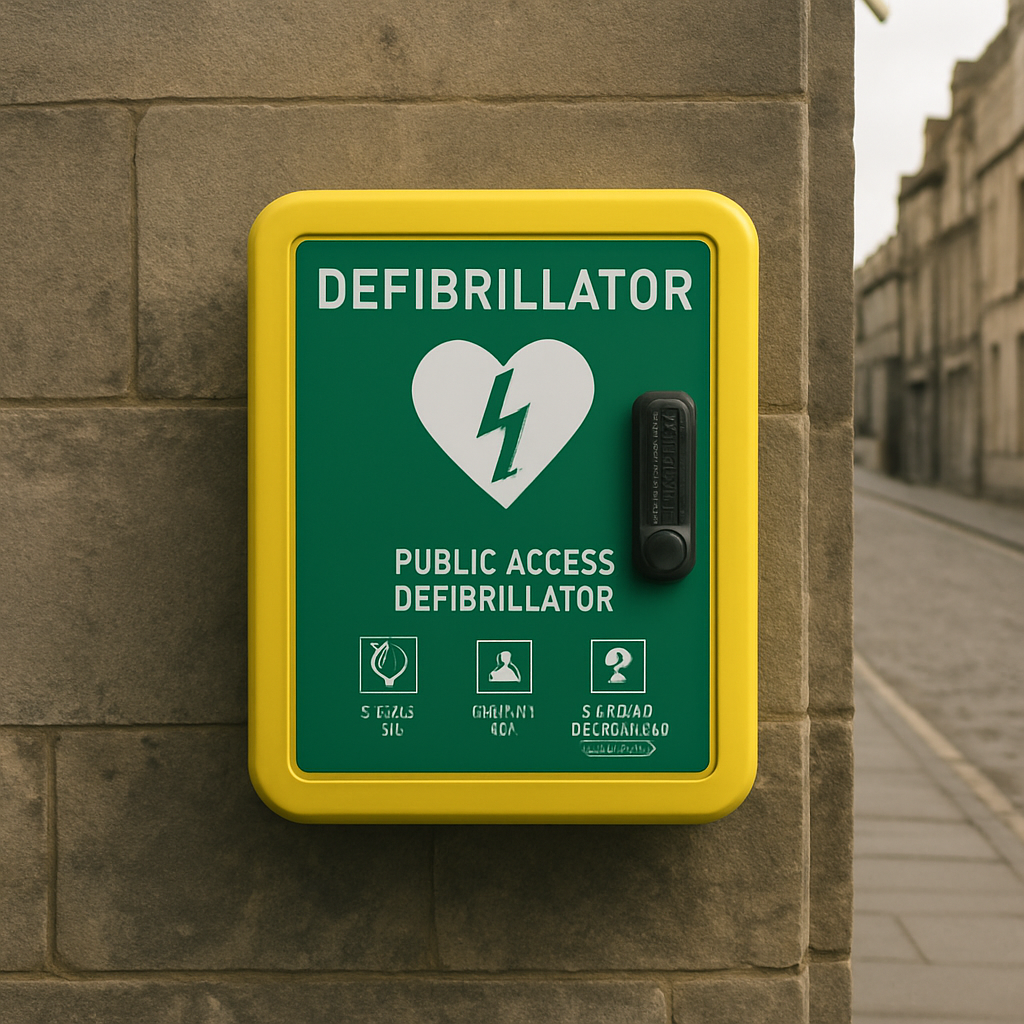
Defibrillators & emergency help in St Andrews.
A public-access defibrillator and bleed-control kit are being installed outside the Nationwide Building Society on Market Street — 24/7 lifesaving equipment in the heart of town. Here's where to find one, and the calm, simple steps that genuinely save lives.

Knowing where your nearest defibrillator is — before you ever need it — is one of the most useful pieces of local knowledge there is.
In June 2026, Fife Council granted permission for Nationwide Building Society at 151 Market Street to install an external defibrillator and a bleed-control kit, each in its own secure, brightly coloured cabinet. Because the branch sits in a B-listed building within the St Andrews Conservation Area, the plans were carefully designed so no original stonework is altered — but the equipment stays bright and visible so anyone can spot it in an emergency.
It's a small thing that could one day matter enormously. We drive this town every day, so we wanted to gather what we know about emergency help in St Andrews into one clear, calm page — the kind of thing you hope you never need, but are very glad to have read.
Where to find a defibrillator in St Andrews
Public-access defibrillators (often labelled 'AED' or 'PAD') are kept in clearly marked external cabinets so they're available around the clock. The newest is on Market Street; others are dotted around the town and surrounding villages.
Nationwide Building Society, 151 Market Street
The newest unit: an external defibrillator and a bleed-control kit in secure cabinets, right in the centre of town with 24/7 public access.
Around the town centre
Several businesses, halls, sports facilities and public buildings host cabinets. If a cabinet has a keypad, the 999 call handler will give you the access code when you call.
Check the live national map
The Circuit (thecircuit.uk) is the UK's official defibrillator network used by the ambulance service. It shows registered defibrillators near you — worth a quick look so you know your nearest before you ever need it.
Out in the East Neuk & villages
Many surrounding villages have community defibrillators, often on the wall of a village hall, shop or old phone box. If you're heading out of town, note the location as you pass.
What to do in a cardiac emergency
If someone collapses, is unresponsive and not breathing normally, every second counts. You do not need training to help, and you cannot make things worse — doing nothing is the only real mistake. Keep it simple:
1. Call 999 immediately
Ask for an ambulance. Stay on the line — the call handler will guide you through everything and tell you where the nearest defibrillator is and any cabinet code.
2. Start CPR
Push hard and fast in the centre of the chest, about twice a second, and don't stop. If you're untrained, hands-only CPR is enough — the 999 handler will keep you in rhythm.
3. Send someone for the defibrillator
If anyone else is around, send them to fetch the nearest defib while you keep doing CPR. If you're completely alone, the call handler will advise — usually keep doing CPR.
4. Turn the defibrillator on and follow it
It talks you through every step out loud and will only deliver a shock if one is needed. You genuinely cannot get it wrong — just switch it on and do exactly what the voice says.
Bleed-control kits & serious bleeding
The Market Street cabinet also includes a bleed-control kit. These are designed for catastrophic bleeding — a serious cut or trauma where someone is losing a lot of blood quickly.
Call 999 first
As with any emergency, get an ambulance on the way before anything else, and follow the call handler's instructions.
Apply firm, direct pressure
Press hard on the wound with whatever clean material you have — or your hands. Don't let up; firm continuous pressure is what slows the bleeding.
Use the kit if one is to hand
Bleed-control kits contain dressings and a tourniquet with clear instructions. They're built to be used by ordinary members of the public under 999 guidance.
Keep them warm and reassured
Talk to the casualty, keep them as still and calm as possible, and stay with them until the ambulance arrives.
A few sensible things to know
You won't get into trouble for helping
Stepping in to help someone in an emergency is always the right call. Defibrillators are made for untrained members of the public — that's the whole point.
Know your nearest one now
Whether you live here, study here or are visiting, take thirty seconds to note the defibrillator nearest your home, hall or hotel. It's the kind of knowing that occasionally saves a life.
In any doubt, call 999
You don't need to diagnose anything. If a situation feels serious, ring 999 and let the experts decide — that's exactly what they're there for.
We carry first-aid awareness too
Our drivers know this town and its routes inside out. In a genuine emergency, though, 999 and the nearest defibrillator come first — always.
Local knowledge that matters.
We gather the practical things worth knowing about St Andrews — from where to park to where the nearest defibrillator is. If we can help you get around town safely and easily, we're only ever a phone call away.
Get in touch